Hacker News new | ask | show | jobs
by gustavus 43 days ago
So despite a borderline fanatical implementation of solar by almost every major government for 20+ years and virtually no new Nuclear plants for 30+ solar is just barely surpassing solar?

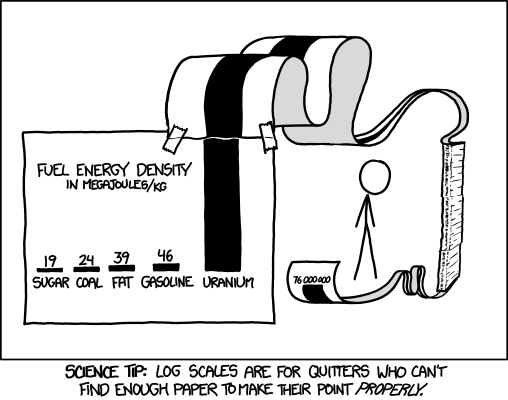
Whenever there is a discussion about nuclear I always remember this XKCD https://imgs.xkcd.com/comics/log_scale.png

9 comments

Nuclear is to solar in terms of energy generation what hydrogen is to electric for cars: it's proponents keep arguing that the other thing doesn't work and will never work, and that you absolutely, positively need their approach. And then it just works and effectively kills off the other technology within a couple of years. Nuclear is basically already dead, and anyone starting new nuclear projects now will look extremely silly in 20-30 years when they finally come online.
They might not look silly because they will have material from which to make nuclear weapons, which is the principal reason we have nuclear power at all.
I definitely would not describe implementation of solar as "fanatical" by most governments, especially 20 years ago. The growth of solar is very recent, it's beat nuclear rather quickly and it's also growing very fast. A huge portion of the world's solar infrastructure is just the last 5 years.

https://en.wikipedia.org/wiki/Growth_of_photovoltaics

> I definitely would not describe implementation of solar as "fanatical" by most governments

Idk, when you because of that implementation, for 20 years pay for the energy 10 times more comparatively to coal generated energy, that seems pretty fanatical by me.

> 10 times more comparatively to coal generated energy

Only when you completely ignore the cost of its externalities, of course.

For 2024, worldwide $6.7tn in implicit subsidies (that's the externalities) plus $725bn in explicit subsides, for all fossil fuels.

https://www.imf.org/en/publications/wp/issues/2025/12/20/und...

Er, yes, that's exactly the behavior you would expect of something growing exponentially - it looks slow at first and then suddenly overtakes things. 23-27% annual growth takes a while to really get moving.
> fanatical implementation

Not supported by the stats in TFA:

>According to the report, the gap between renewables and nuclear widened substantially in 2025. Global solar capacity increased by 510 GW to 2,383 GW, up 27% year on year,

Sounds like a quarter of the growth was in the past year.

Most of it has been installed in the last 4-5 years, and we are still accelerating.

https://ourworldindata.org/grapher/installed-solar-pv-capaci...

World is almost at 1TW/year solar PV deployment rate. China has enough PV manufacturing capacity for double current global demand. We aren’t done going fast yet, we’re going to go faster.

We solved fusion at a distance with cheap solar and batteries. And not a moment too soon.

China themselves could have installed all of that capacity. But they are limited by batteries and other infrastructure and are catching up to those while planning a bigger play in the dessert solar farm.

They plan to increase 50% for Wind and Solar in 5 years, and possibly double in 10 years. Since 80%+ of all future planned Nuclear reactor are also in China, they would have more than double their renewable energy in 10 years. China is the number one in electricity production and usage, more than twice the size of US and 33%+ of the world. Given the size of China this is both exciting and scary.

If China has decided to save the world from climate change as a second order effect from keeping their deflationary manufacturing system operating and for national energy security reasons, I have no complaints. I do not care why, it is immaterial, just keep the solar, wind, batteries, and EVs printing as fast as possible to the world. We have to get to net zero as fast as possible, and then sequester all of the carbon emissions emitted as climate carbon debt since the Industrial Revolution started. That’s a lot of work left to go.
That’s awesome, and more evidence this hasn’t been “20 years” in the making.
I am mostly pro-nuclear, and the comic is funny, but of course we extract energy from sugar, coal, fat, and gasoline via oxidation, while we extract energy from uranium via fission. So the more relevant variable being demonstrated in the comic is chemical process vs nuclear process, not how much energy is "in" the fuel. And that comparison is a lot less cut-and-dry.
Good luck getting fission to work on any of the other materials.
Well, what would you expect a solar rollout to look like?

Assuming we'd instantly switch from zero solar demand to unlimited solar demand, we'd need some kind of scaleup of PV manufacturing first, and with a fixed construction capacity of PV factories we'd see a linear rise in PV factory capacity - which would result in an exponential growth in yearly PV factory output.

But the same applies to the factories as well: the construction capacity is going to scale up as well, so as more PV factory part manufacturing becomes available we'll start to see an exponential growth in new PV factories, which would result in even larger PV factory output.

Scaling from "lab experiment and niche application" to "significant chunk of the grid" is a lot harder than scaling from "significant chunk of the grid" to "the entire grid" - especially with solar being embarrassingly parallel rather than requiring mega-scale deployments.

China is building a lot of nuclear, and in my home province in Canada they are planning to expand nuclear infrastructure (we will see if it comes to pass).

Solar just thrives in places without dependable established grids and has way lower buy in.

Two different tools for different things.

The first TW of solar capacity took 60 years to reach. The 2nd TW took 2 years. We've reached the inflection point.
It really is sad how ugly solar is. Miles and miles of beautiful, peaceful open desert are ruined. It's a bit of an environmental travesty.
Utility scale solar PV restores deserts. It also compliments agriculture use cases (“agrivoltaics”).

If you believe solar is ugly and deserts are beautiful, well, “beauty is in the eye of the beholder.” I believe clean, solid state hardware that will reliably produce low carbon energy for decades without causing any harm and potentially contributing positive benefits to its surroundings, with no other inputs required, is incredibly beautiful. Like simplicity, it is the ultimate sophistication (da Vinci).

The Great Solar Wall: China doubles down on its ambitious effort to tame deserts - https://www.scmp.com/news/china/science/article/3363108/grea...

Triple win: solar farms in deserts can boost power, incomes and ecosystems - https://www.nature.com/articles/d41586-024-00516-8

Swathes of Earth are turning into desert — but the degradation can be stopped - https://www.nature.com/articles/d41586-023-03621-2

https://en.wikipedia.org/wiki/Agrivoltaics

You're aren't looking at all factors here. I look at solar and think its beautiful for what its displacing.