Hacker News new | ask | show | jobs
by vladms 6 days ago
The problem is that currently probably nobody can provide food that is cheap, good, healthy and available all year around.

Then what are the options? Force people to eat healthy and expensive? Allow everybody to produce cheap and unhealthy? The current situation seems like a compromise: whoever cares and can afford will buy European stuff (more expensive, probably more healthy); who can't afford can still buy cheap stuff.

Ideally, I would like stricter controls at the border, to eliminate some of the worst offenders. But even ignoring that, allowing lots of new pesticides in European soil (not that fields are not probably full of stuff already) will have direct cost on health care in the years to come.

8 comments

>available all year around

Since when did this become a standard? For our entire history, food was not available all year around. We ate seasonal food and preserved food for later. We mostly ate things that could be grown locally. Everything else was luxury.

I don't know, but is what I see that people expect. I tend to try to buy things grown in the season but 90% of people I talk about don't know/don't care.

If you would force a large part of the population (by high prices, taxes, etc) without them understanding and agreeing to the reason, you would get a revolution and you would have failed.

Maybe 30 years ago some rich nations could afford to buy thing all year long, and maybe at that time they were OK (less pesticides). And then more nations wanted that => hard to keep up with the production => more chemicals used => less healthy. This is just a theory, wanted to say that the desire might not have been inherently "evil" from the start, and we have to deal with the situation now.

Who knows when it became a standard, but it is enough of a standard now that denying it could lead to social unrest, and that is the last thing the EU needs now. For years now, people have noted how the CCP has taken pains to keep pork affordable to its population: in the past most Chinese ate little meat, but once they got it, depriving them of it would risk explosion. Same thing with seasonal foodstuffs.
The US was the first country to eliminate famine, in the early 1800s.
Thats not quite the same as ensuring that everything is available all year round.
Elimination of famine also relies on a transportation network across the country, so food can be grown here and shipped there all year round as necessary.

The 1800s in America saw a vast extension of railroads and canals which served that purpose.

Literally not true. There are countries that haven't had a famine since before the US even existed.
Using native crops and preserving enough food to last the unproductive months. That’s the point.

Not by trying to eat chocolate, coffee and bananas year-round.

i mean, the first two are quite easy to preserve.
The quest to extend shelf-life and product appearance after extended storage rather than simply eating organic, locally grown wholes foods is a potential candidate cause for emerging issues such as the dramatic increase in colorectal cancer in younger people in the West.

Synthetic or processed emulsifiers (carboxymethylcellulose, polysorbate-80, etc) are increasing being linked to changes in the gut microbiome and inflammation triggering.

https://pubmed.ncbi.nlm.nih.gov/40816342/

https://pubmed.ncbi.nlm.nih.gov/34774538/

https://pmc.ncbi.nlm.nih.gov/articles/PMC7986288/

https://www.nature.com/articles/s42003-024-06224-3

> The problem is that currently probably nobody can provide food that is cheap, good, healthy and available all year around.

We can, but we feed it to livestock instead of humans. Obviously, we'd want some improvement in quality control for human grade food, but the capacity is there.

Corn and soy is not good human food. We have already shifted a huge proportion of grocery store shelves to these feed products. We would all be better off if we ate less of that stuff. Let the dorito fingers bring the donwvotes.
Polenta has been a staple starch in Southern Europe for centuries (and indeed was regarded as superior to things like millet that were common before the Columbian exchange brought corn). Obviously one couldn't force it on a population not used to it, but corn works fine as human food.
Polenta, tofu are staple food as well as pasta and oats. Cheap, available all year round.
Traditional foods made at home are not the same things as the boxes on our grocery stores. These two crops in particular are grown specifically to fatten livestock. In no world is that animal feed ground into boxes good food. Not to mention most commercially grown corn and soy is "round up ready". Yuck.
You think people are growing corn or soya in their own homes? People eating the foods mentioned by me and the other poster are buying them ultimately from agricultural producers. The "traditional foods made at home" come from "boxes at the grocery store".
> The "traditional foods made at home" come from "boxes at the grocery store".

Maybe yours are. That's not true for all by any means.

You can just move subsidies from corn to protein based food. Agriculture eats around 33% of all payed subsidies and 33% of that goes to corn.

The food pyramid everyone gets shown at school is reversed to how it should be.

>The food pyramid everyone gets shown at school is reversed to how it should be.

That food pyramid existed for 13 years only, and every single other diagram of food from the USDA has been basically the same in recommendation since the 60s:

Eat different kinds of foods. Don't eat too much.

Basically, if you are angry about that food pyramid, so were educators and everyone else and Fucking George Bush Jr who had it replaced the moment he could. I was explicitly taught it as an example of government corruption and poor incentives. In elementary school. If you treat it as anything other than a temporary stupid event, you are falling for hypertargeted propaganda. The cohort of people who were taught that pyramid but not taught a newer one or taught explicitly that it was bad was like a couple years of Gen Xers.

Arguably the continued existence of milk in the myplate era should have gotten far far far more drama than the 90s pyramid.

Buffalo wings are just as bad for you as Corn chips. It doesn't matter what you drown in butter/oil, cream or cheese.
There's nothing at all unhealthy about butter or chicken. If you're lactose-tolerant there's nothing wrong with cream and cheese either.

People get fat from excess carbohydrates. Corn is an awesomely abundant carbohydrate, and corn chips are often coated with delicious flavorings that make you want to eat tons of them.

People get fat from excess calories from filling up with calorie-dense foods. Truth is that while your taste-buds guide you to calorie-dense foods the process that tells the body it ate enough is purely mechanical, how full the stomach is physically. Modern (slim) professional competitive eaters or beriartrich surgery are examples of how you can game the process.
> The food pyramid everyone gets shown at school is reversed to how it should be.

Very interesting idea. Can you provide a source for the claim? Harvard's Healthy Eating Plate is currently among the most authoritative diet guidelines. It doesn't look at all like an inverted food pyramid to me.

Might have been in reference to earlier versions of the pyramide, which exactly the Harvard team had been fighting against for a long time because of its overreliance on animal products (mostly meat but also dairy) and cereals.

Edited for readability

THIS. Just replace corn with grain. (False friends)
Whatever the agricultural subsidy obsession is with corn in the U.S, it doesn't apply to Europe.

Same goes for the food pyramid. While the concept of a food pyramid was invented in Sweden, they differ from country to country, so the one you've seen is not the one most Europeans have seen.

> The food pyramid everyone gets shown at school is reversed to how it should be.

Good news: nobody has been shown a food pyramid in school for the last 15 years[1].

[1] https://www.isu.edu/media/libraries/rural-health/microgreens...

It’s still there, in politics. The subsidies go straight where the food pyramid showed all those years ago.
> Then what are the options?

Expensive and perhaps limited import licenses, to force the everyday diet to come from locally grown crops and be seasonal. Prices for staples will stay low because market is a dynamic system so locally grown supply will quickly increase once it doesn't need to compete with cheap imports. Then the govts will have any chance of controlling methods and chemicals used in agriculture, too.

So, "we force them but it's for their own good!" strategy? I think use of force (at the limit - you raise taxes too much, you get protests, you need to use violence) generally does not lead to great outcomes.

I would prefer education and information (like clear labels), even if we would "loose" 40 years. If people understand the reason and can act on it, you don't need anybody "to enforce it"

Genetic engineering, or keeping pests away with a physical barrier. You might still need pesticides but only in places that have an actual infestation.

But I think a secure supply of cheap food is more important than preventing a minor health risk. And I would support engineering humans to tolerate these things better.

If you remove “cheap” can you have “good, healthy and available year round”? Obviously making food way more expensive would be terrible for most of the world, but for the rich world it seems like cheap food is just paid for in healthcare costs.
Yes. There are winter vegetables.

It does mean going back to seasons and growing food that matches the climate. That being said, some places like Spain or Greece probably make foods year-round in a greenhouse.

> Then what are the options?

Bugs, obviously. But then the right wing wackos and the Dutch famers party that are pesticide addicts will start screaming that the EU makes us eat bugs.

Its not obvious at all, for how long have bugs been a part of our diet? How many generations of people grew on it? I don't trust my life to some modern sponsored 5 year study
Since prehistoric times. It's not part of the staple diet in all cultures, but for subsistence, humans would never turn up their noses at easy protein and calories.
In Asia bugs are eaten regularly. It's absolutely safe to eat, it's just protein. Only people feel uneasy about bugs in general so they refuse to do so. Me included.

Generations which grew in abundance of calories and nutrients are very novel too. Ultra processed foods too, yet a lot of people perceive them as "safe" even when they are literally poisonous.

See the argument of bugs being eaten regularly in Asia isn't very good, you know alcohol is consumed in Europe for centuries, but asian person can get sick just from one glass of beer (I actually saw this happening to a colleague from Taiwan).

Asian diet or lifestyle might include more stuff that makes bug diet work, like in India they are fine with super spicy food that in many places would be considered unhealthy.

Yes, living organisms can be infected by parasites or diseases that can be transmitted to humans if not properly treaded. Even if its beef, bugs, fish, chicken, eggs, milk or even lettuce.
How often do you voluntarily eat bugs? Why haven't you already started eating bugs, or are you waiting for the EU to make you as you claim right wingers say? Lead by example.

You know what's funny, the African and Indian colleagues I talk to here in the EU say we're crazy. Their goal back home is to get out of poverty so they can use more energy and buy more and better things to make their lives easier and more comfortable: more private transportation, more meat consumption, more AC, more housing, meanwhile Europeans are doing everything to get out of prosperity to living in poverty: less kids, less and smaller housing, less meat consumption, less of everything, no-AC, as some sort of noble sacrifice for the benefit of everyone else but their own.

They can't imagine living in one of the richest places on the planet and people not being able to afford to eat meat like they do back home in poorer areas of the world.

Do you care about "having stuff" or about being "happy"? I seen countries (western Europe) where they are "happy" while having less stuff (although large bank accounts, so not poor).

At some point the obsession with doing X, is just that. I do eat meat occasionally, but is it that horrible if I eat it every other day or once a week? For me not at all, I do enjoy lots of other stuff. In fact I think that the ones that insist to eat meat every day in large quantities are not enjoying other great food because they are obsessed with "having". I had people over saying "wow never imagined food can taste so good without meat".

Plus, I really liked one type of bugs when I was in Mexico (not all though). Can't find them (easily) in west Europe. So, not sure why people are so much against bugs - doubt that 90% even tried, they are just afraid of "new things".

>Do you care about "having stuff" or about being "happy"? I seen countries (western Europe) where they are "happy" while having less stuff (although large bank accounts, so not poor).

Happiness is subjective to each individual, not a nation, and impossible to measure and compare nation to nation. But being able to afford more stuff is easy to compare. The leader of Singapore said the same thing on the topic that Singaporeans fell unhappy despite being prosperous: and he replied that a country can only provide you with prosperity, not happiness that's vague and unmeasurable, you have to make your own happiness.

> I seen..

I also see many things, different than you. So who is right?

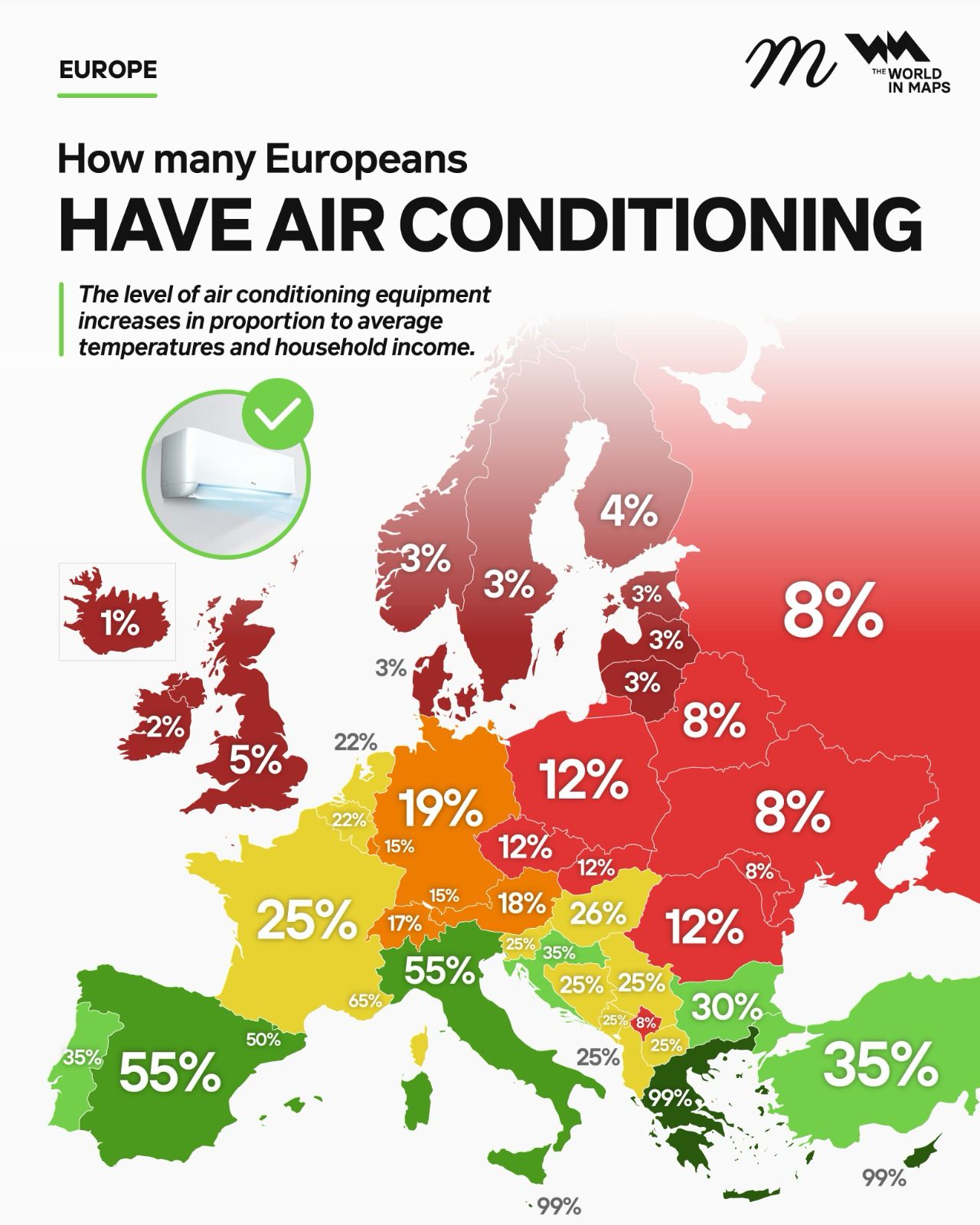
The AC angle are just dumb memes coming from the US. There is not so many AC because it wasn't needed here. In south of Europe its literally everywhere, there we're simply not these crazy summers in the past. Almost all the points you mentioned are happening mostly because as advanced Europe is, it is also particularly more expensive. Your generalisation is based on some specific delulu marginal part of Europeans using very specific moralistic arguments.
>The AC angle are just dumb memes coming from the US.

It's not a meme, it's a fact, and it's coming from me, an European. The fact is some EU countries (Austria, Germany, etc) have very high regulatory roadblocks to AC installations in city apartment buildings (where the need for AC in summer is highest since cities are hotter than the countryside or suburbs).

And on top of that, some populations themselves, like Austrians, are so rabbid NIMBYS against AC installations they'll even call to report you to the local authorities simply to complain that you got an AC installed, and then inspectors come check your AC, "because a neighbour complained". It's like a crabs in a bucket because they've been brainwashed ACs are evil and if you install one it must be illegal.

>There is not so many AC because it wasn't needed here

I never said it wasn't needed in the past, I'm saying it's needed NOW, and some countries refuse to accept the new reality and cling on to the old times. Like that new hospital in germany which was built without AC and they had 30+ C in the operation room this past summer. Bonkers! Imagine the health hygiene/infection risks.

A mate works at Siemens, one of Germany's richest companies, and they decided this year not no install central AC in the building, even though they had 30+ degrees in the office and people couldn't focus properly, because it would cost 300k Euros, the salary of a SV engineer. This Europoor "penny wise and pound foolish" mindset will be the death of us.

>In south of Europe its literally everywhere, there we're simply not these crazy summers in the past.

Heatwaves are everywhere now too, not just in southern Europe but some countries are dragging their feet when it comes to normalizing the installations of ACs in apartments with delulu moralizing justifications around "protecting the environment", even though ACs are heat pumps, which the same environmentalists champion for winter heating, but somehow they're evil when used for summer cooling. You can't reason with these people, and some countries are infected with them due to lies and propaganda.

>Your generalisation is based on some specific delulu marginal part of Europeans using very specific moralistic arguments.

I didn't generalize, I talked about what it's like where I live, as that's the relevant reality for me, so that's what I'm gonna mention it.

Of course there would be some clowns using moralistic angle, but mostly it was simply not needed. It simply correlates with weather.

But I agree, some people are just fucking stupid. In Southern parts of Europe there are AC's on buildings everywhere and I think this would happen in Northern parts too. This is just unbearably stupid.

https://worldvisualized.codexcdn.net/assets/as23puvmakoJ6mrx...

The thing is, nost newer heat pump inverter ACs work great for heating too, not just cooling. And they can use clean electricity, as opposed to Russian gas.
Do you have a source for that map? As it REALLY doesn't match the reality I know from living in some of those countries.
Actually in Germany some are quite against Klimaanlagen. They had an excess of deaths during the heatwave last June. If they're ready to die because of moralistic arguments, they should go ahead, I won't argue with them. Same goes with eating bugs.
German environmentalist movement has been crazy for a long time, perhaps because they were a tool by KGB / FSB to get Germans hooked on cheap Russian energy, and to promote pacifism. Thankfully, Germany is not whole Europe. In most countries environmentalists are simply pro-renewables/nuclear, and don't oppose using that green energy for obviously useful things like air conditioning during heatwaves.
Exactly. Systematic radicalisation of absolutely deranged left wing extremists in Germany is seventy year's old Russian tactic. This is not new, only new thing is how Germans let themselves be fooled now.

They are The Ones I had in mind when writing my commentary.

I'd like to try some that were authorized as fit for human consumption, preferably not very processed, like precooked or dried actual bugs, but I haven't seen any in stores for obvious reasons. I saw some cricket chips sold as sports nutrition, but they were quite expensive, so I passed. I like to joke about it by calling 'em land shrimp.

Anyway, those people advocating banning beef should eat some bugs every time they come up with these crazy ideas, trying to control other people's diets. Yes, we do like our steaks. So what? I'v been a vegetarian for four years. It was a stupid decision.

You know, foxes and other small canine diets' include lots of insects. Why wouldn't mine?

>You know, foxes and otger small canine diets' include lots of insects.

The diet of dogs also includes eating their own poop. I'd rather eat like a modern civilized human, not like a canine. But you go ahead.

That's false. It's actually an eating disorder in some young dogs, mainly originating from kennels.
> How often do you voluntarily eat bugs?

When eating organic foods? Definitely sometimes, it’s just part of eating food and it’s not a big deal, I rarely notice and obviously take it out if I see a big one, but I’m not blind to the fact that by choosing organic foods I’m also getting a few bugs sometimes, it seems worthwhile to avoid the pesticides

Note that the parent wasn’t saying to eat a bug burger, they were just saying by greatly limiting pesticides we have more bugs in our food